
Automating SEO operations across a seven-store dealership portfolio.
An agency that runs SEO for car dealerships spent about 14 hours a month per store planning, writing, posting and auditing, across seven websites on three different platforms. Loque Logic built the automation that now does it on a schedule. The work takes about 2 hours a store, and the system refuses to act when it isn't sure.
Free 30-minute conversation about how your business runs. Practical recommendations. No obligation.
Prefer to talk? Call (435) 243-5808 about your workflow, or .
The case study, in five parts.
Every case study we publish reports the same five things, so you can judge the result for yourself.
- The workflow
- SEO operations for a dealership portfolio: planning technical and content SEO, writing and publishing blog posts, landing pages and Business Profile articles, keeping internal links accurate, auditing each site weekly and reporting to the client. Built custom, because three different CMS platforms left nothing off the shelf to configure or connect.
- The baseline
- About 14 hours per dealership per month. Creating and posting blog posts, Business Profile articles and landing pages took about 10, even with AI writing help, and the audits took about 4. Across seven stores, that’s about 98 hours a month. These are estimates.
- The volume
- 7 dealership websites of 600 to 2,200 pages each, 48 tracked link categories per store, 3 CMS platforms, and a new set of blog posts, landing pages and Business Profile articles for every store every month.
- The result, and its kind
- Capacity recovered. The same work now takes about 2 hours per dealership per month, most of it on the audits: about 14 hours a month across the portfolio instead of about 98, estimated. Alongside that, measured: links verified, articles published, live posts repaired and site findings tracked.
- What it costs to run
- About $3 per dealership per month, or about $21 a month for all seven stores.
- Client
- An SEO and digital marketing agency serving car dealerships
- Portfolio
- 7 dealership websites across 3 CMS platforms
- Build
- About 100 hours to build and implement, with the first seven modules running in under four weeks
- What it replaced
- Content written and posted by hand even with AI writing help, hand-checked links, and audits kept in spreadsheet punch lists
- Stack
- TypeScript, Node.js, Playwright, AI agents, Claude API, ChatGPT image generation, cloud image storage, Postgres (Neon), Google Workspace APIs, n8n, Microsoft Teams
Manual work, repeated across seven websites.
An SEO agency's value to a dealership comes down to a few things done consistently: accurate internal links, fresh content on schedule, and site problems fixed before they cost rankings. Every one of those was manual work, repeated across seven websites.
The agency needed automation it could trust with live client websites. A tool that's fast but sometimes wrong would have been worse than doing the work by hand.
- 01
Links drifted without warning
Each site has 600 to 2,200 pages, and the agency tracks the right page for 48 link categories per store. Dealership platforms reorganize URLs without telling anyone, so the spreadsheet of link targets was always going stale.
- 02
Content was a production line run by hand
Even with AI writing help, it took about 10 hours per store every month. Blog posts, landing pages and Business Profile articles each needed internal links and images, then had to be pasted into the CMS, given their SEO fields and scheduled.
- 03
The websites weren't one platform
The stores run DealerOn and two different WordPress builds. During the project, four stores moved platforms with no notice.
- 04
Audits produced lists nobody could keep current
Each audit took about 4 hours per store per month. The findings lived in spreadsheets that went stale as soon as they were written.
One system, from the SEO plan to the client report.
Each part runs on a schedule and records what it did, so the team can check it.
SEO plan per dealership
The system creates a technical and content SEO plan for each store and keeps it current. Every month’s pages, posts and fixes come from that plan.
Link Scanner
Every Friday it reads each dealership's sitemap, sorts every URL into the 48 link categories and updates the link repository. When a page moves, it archives the old link, records why, and queues the old URL for a 301 redirect.
Content generation
Each month it writes the blog posts, landing pages and Google Business Profile articles in the plan, through the Claude API. Everything is linked internally from the verified repository and has to pass checks on word count, tone and duplicate topics before it’s saved. A Business Profile article never quotes a price or rate the post it promotes doesn’t state.
Custom images
For every article it writes a prompt and has ChatGPT generate a custom image. The image is stored in the cloud, optimized for SEO and cropped to each platform’s spec.
Publishing to the CMS
Using RPA and APIs, AI agents sign in to each store's CMS, create the pages and posts, build their on-page SEO and set the schedule, with no one involved. Each store's steps live in their own file, so a platform change touches one file and no other store.
Live content repair
The robot edits articles that are already published. When links inside live posts went dead, it fixed them in place without changing the publish date or URL, and confirmed each fix from the public page.
Weekly SEO analysis and punch list
Every week it analyzes each site and turns what it finds into a punch list for the team to work through. Each issue is tracked from found to fixed, and when a fix belongs to the website vendor, it drafts the escalation.
Weekly client report
At the end of the week it notes which punch-list items were completed and what content went live, then sends the client a report for each dealership.
Operations dashboard
Every client, every scheduled run, the content pipeline and the punch list in one place. It replaced the punch-list spreadsheet as where the team edits findings.
Everything runs from one shared data layer, moving from Google Sheets to Postgres one table at a time, and alerts go straight to Microsoft Teams.
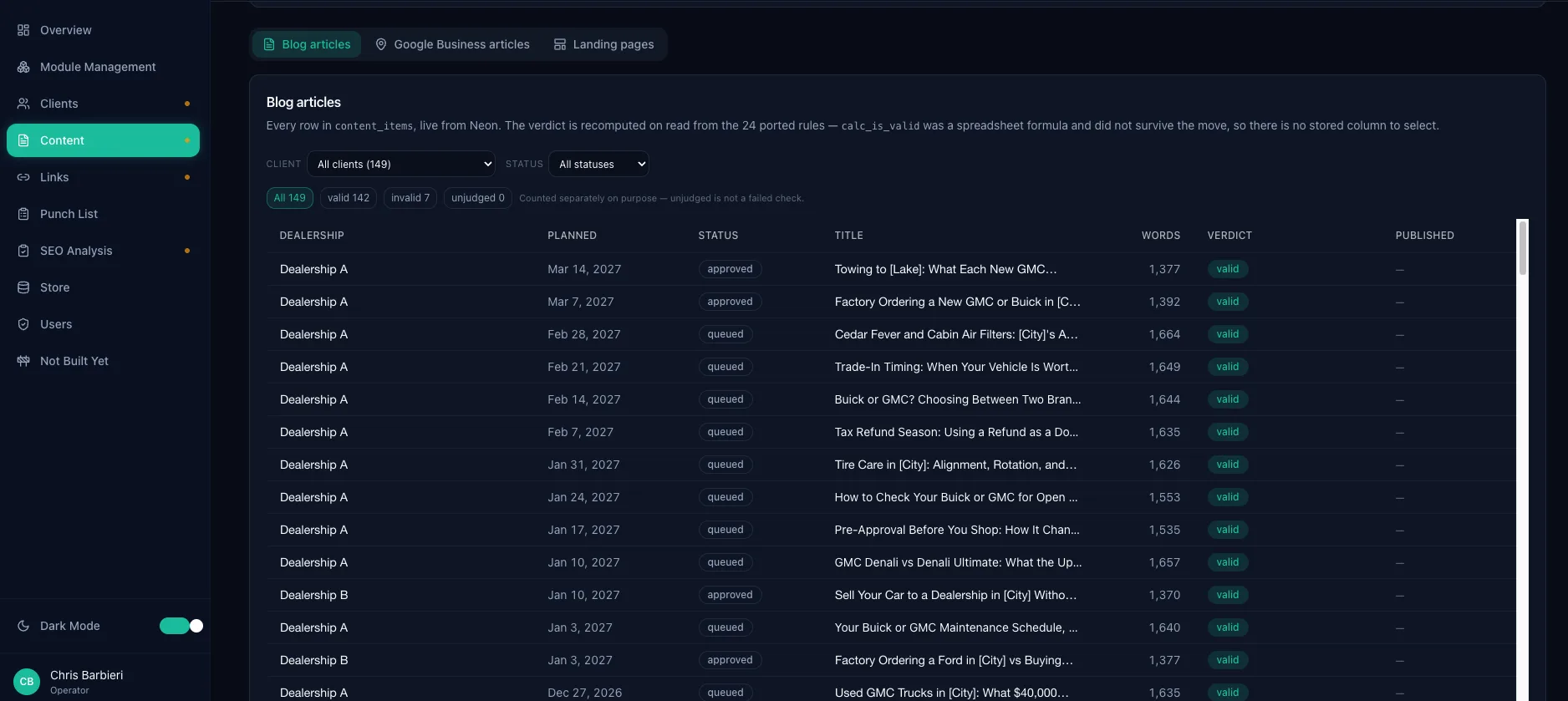
What it has done so far.
Hours, build time and running cost are estimates. Everything else is measured, as of September 2026. Every published post had working internal links after the repairs.

Automation you can leave running, because it refuses when it isn't sure.
Built to be trusted with live client websites.
Speed was the easy part. Most of the engineering went into making sure the system never damages a live site and never reports success when it has failed.
It refuses when it isn't sure
Early on, one scan reported that 41 of 48 links at a dealership had disappeared, while its own checks showed all 41 pages were live. A failed read of a site looks exactly like an empty site. Four independent safety brakes now stop any write from a run that can’t be trusted, so a bad read costs a week of stale data at worst, never a deleted record.
Two locks on every change
Nothing changes a spreadsheet, database or client website without two separate confirmations, and every run can first go as a dry run listing every change it would make.
Try it on one post, then check the page
A change to a live site runs first on a single post while someone watches, and is judged by reading the public page, not by what the robot reported. On its first run this caught a CMS behavior that would have changed a post's publish date, before any other post was touched.
Silent failures are made visible
A scheduled job that never starts leaves no error behind. So every module records every run in one shared log, and one status command answers: did it run, did it cover every store, and is the schedule still firing?
Least privilege, enforced by the database
Each part of the system can write only the data it owns. A job that checks links can't change one, because the database won't let it.
Every decision is written down
More than 80 short decision records explain why the system works the way it does, so the agency and any future developer can trust it and build on it.
A small team, working in parallel, under strict rules.
Loque Logic paired senior architecture and project leadership with an AI-assisted engineering workflow. AI coding agents worked on separate modules in parallel under strict rules: each stayed inside its own module, every change was reviewed, a written project record was kept current every session, and a person approved every write to a live system.
That's how a small team built a production platform in about 100 hours without cutting corners on safety. The same rules that keep the automation safe kept the development in check.
Where the platform goes from here.
- Automated 301 redirects, fed by the queue the Link Scanner already keeps
- Other kinds of client, since the content engine was designed to serve more than dealerships
What is manual work costing your business?
Repetitive admin, missed follow-ups and disconnected systems take time away from running your business. Bring us one process that slows your team down. We'll help you understand what could improve, how much time you could recover, and what it might cost to implement.
Get My Free Workflow ReviewFree 30-minute conversation about how your business runs. Practical recommendations. No obligation.
Not sure where to start? That's what the free call is for. We'll walk through how your business runs and find the easiest wins, the places where automation and AI agents can take work off your team first.
Prefer to talk? Call (435) 243-5808 about your workflow, or .