
Running a medical supply company’s patients from intake to reorder, one controlled step at a time.
A national medical supply company had been through three ERP systems. Each one handled orders and billing well, and none of them could guide an offshore team through the work around it. Loque Logic built the system that sat between NikoHealth and everything else: intake, compliance, reorders, provider and sales portals. Intake and reorder now need 30% fewer offshore staff, the order error rate fell below 1%, and the company grew 20% year over year while its staff came down 10%.
Free 30-minute conversation about how your business runs. Practical recommendations. No obligation.
Prefer to talk? Call (435) 243-5808 about your workflow, or .
The case study, in five parts.
Every case study we publish reports the same five things, so you can judge the result for yourself.
- The workflow
- Patient intake, insurance verification, compliance review, shipment and monthly reorders for a national medical supply company, worked largely by an offshore BPO team. Connect and build: NikoHealth stayed as the billing system, and we built the process layer around it, connected to the call center, phones, compliance review and pharmacies.
- The baseline
- Stalled intakes and reorders were hard to see. Nothing in the system moved a patient through a defined process, so it was far too easy for a new patient or a reorder to fall through the cracks. There was automation, but none of it knew where a patient stood in the process, when they’d last been contacted or whether they’d answered. It also depended on staff typing in the data, and every manual entry was another chance for a mistake. NikoHealth had few guardrails against those mistakes, and a new BPO staff member took four to six months to get up to speed in it. With turnover on the offshore team there was always someone new. Management spent more than 50 hours a month on reporting. About 25 went on matching new orders to the right reps, and the month still ended in an argument over which sales belonged to whom and what had been missed. Another 25 or so went on the month-end numbers: new patients, cancellations and patients by channel. Even then, the data on which channel a new patient came from was imperfect, so management had little view of which marketing was working. Offshore staffing for intake and reorder before the system (SCOPE §11 item 34)
- The volume
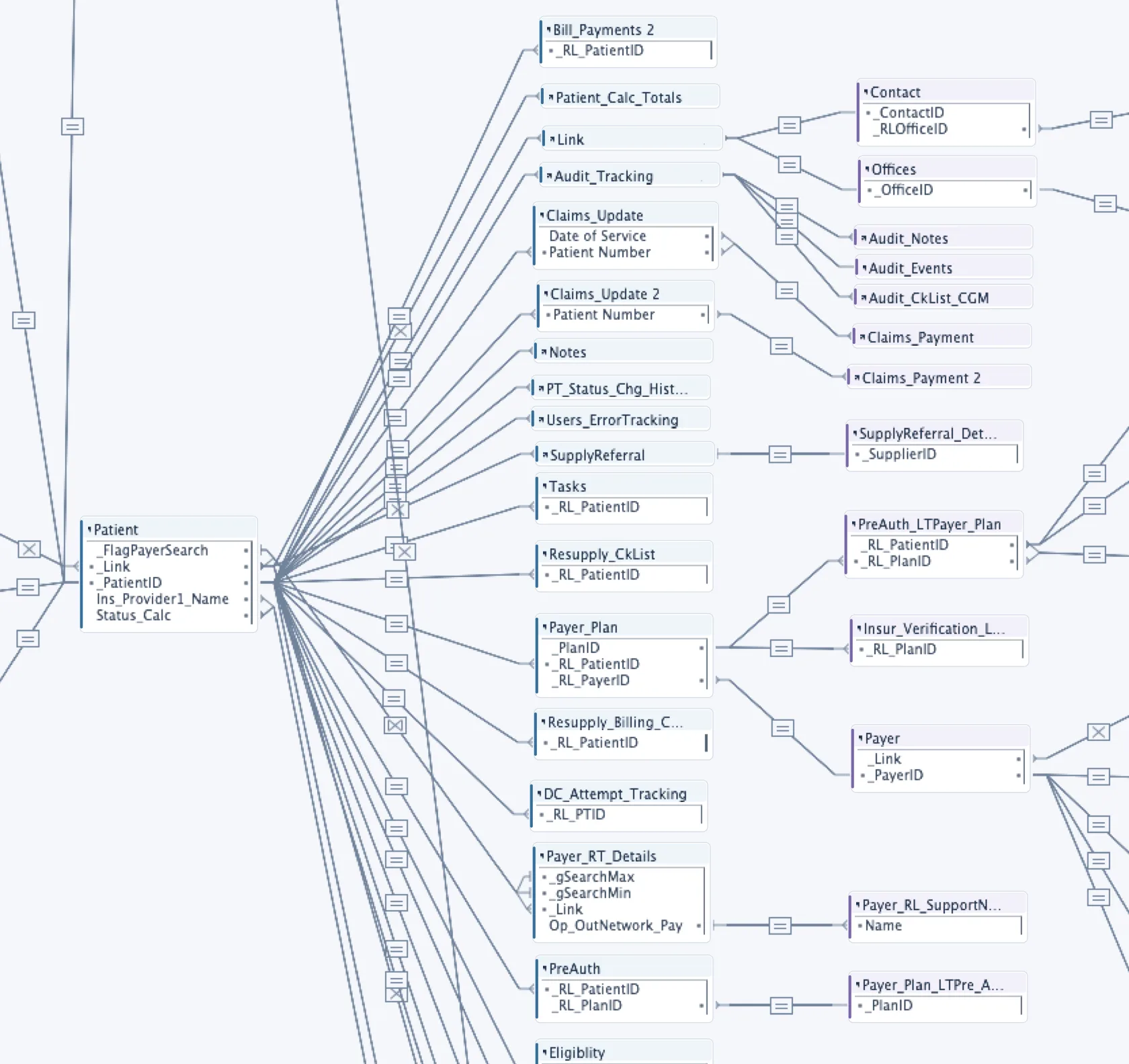
- Patients in 46 states, each moving through a staged flow from intake to shipment and then a monthly reorder cycle. More than 75 related tables, hundreds of automation scripts, and five outside platforms connected.
- The result, and its kind
- Cash saved, capacity recovered and growth enabled, each counted once. Cash: intake and reorder need 30% fewer offshore staff, about $6,000 a month in offshore labor, and sales and management use their own views instead of NikoHealth seats, $10,000 a quarter in licenses. Capacity: management gets back the more than 50 hours a month it spent on reporting, from matching new orders to reps to the month-end numbers. Growth: the company grew 20% year over year while its staff came down 10%. Alongside all three, the order error rate fell below 1%.
- What it costs to run
- About $1,102 a month, with the APIs and integration tools included. About $500 of that is the always-on servers on Azure, which moves with the number of hours in the month, and about $467 is the NikoHealth API. Neon and a few connectors make up the rest. It doesn’t cover the build, or a support agreement.
- Client
- A national medical supply company
- Who used it
- Management, operations, an offshore BPO team, the sales team in the office and on an iPhone app, and the providers and referral sources who send in patients
- Build
- More than 75 related tables and hundreds of automation scripts, rolled out one component at a time
- What it worked beside
- NikoHealth, kept for billing and order management
- Stack
- Microsoft Azure, Azure Event Grid, Azure Communication Services, Anthropic’s Claude, Neon’s HIPAA-compliant Postgres, an iPhone app, the NikoHealth API and RPA, CallShaper, Dialpad, GenHealth, ScriptCycle, SMS and email. Every platform that touches patient data is covered by a BAA
Good billing software, and nothing to run the work around it.
The company tried two other ERP systems before NikoHealth, and all three turned out to be tools for orders and revenue cycle management. None of them was built to guide offshore staff through a defined, controlled process, the kind that keeps mistakes and training time down, or to give management KPIs it could act on. The work that mattered most happened in the gaps between them and everything else the company used.
So the company kept NikoHealth for billing and order management, and we built the system that runs the work between it and everything else. It became the core of how the company operates.
- 01
Billing software, not process software
Every ERP the company tried was good at orders and claims, and had no process controls or process flow at all. Nothing stopped a patient moving to the next stage with a step undone or a wrong answer recorded.
- 02
Three systems in, the gap was still there
Switching ERPs didn’t close it, because the missing piece wasn’t billing. It was the controlled flow of work an offshore team needs.
- 03
The rest of the operation lived outside
Call center intake, phone calls, compliance reviews of patient records, reorder outreach, sales attribution and provider updates each sat in a different place, or nowhere. Automation and AI in the ERPs were limited.
- 04
Nobody could see where sales came from
None of the existing systems tied an order back to the rep or referral source behind it. Management spent about 25 hours a month matching new orders to reps by hand, and the month still ended in disputes over attribution and missed sales.
- 05
Nobody could see the pipeline either
NikoHealth had no real-time view of patients moving through the process, which ones were going stale, or how new patients and cancellations were trending. Reps who wanted an update called operations or management.
Every tool here filled a gap between systems the company already had.
The process flow sits at the center. Everything else feeds patients into it, checks them inside it, or shows people where they stand.
Staged process flow
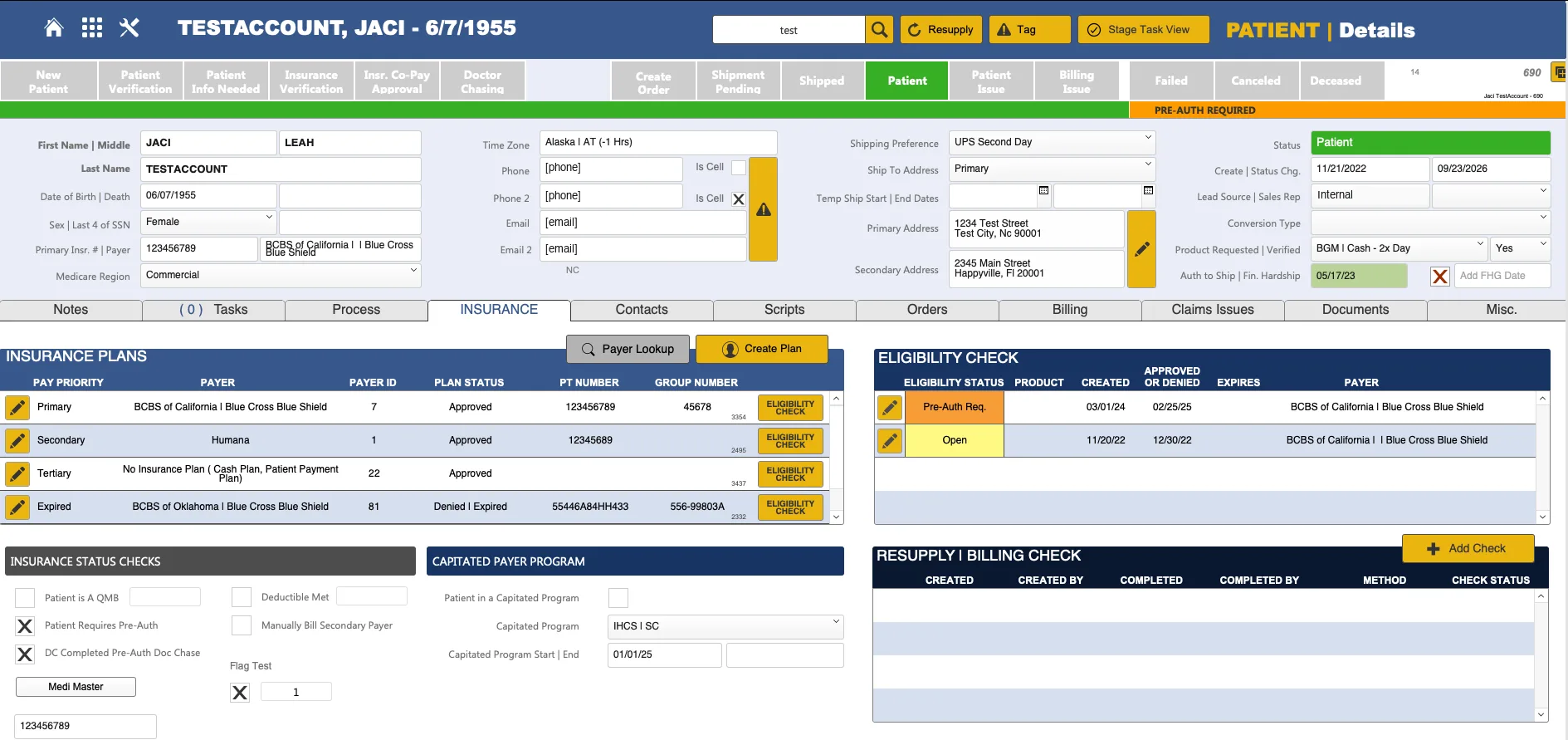
Every patient moves through defined stages from onboarding to shipment. At each stage the team completes a checklist and enters the data it asks for, and the system forwards the patient or fails them back based on the answers. Nobody can push a patient forward with a step incomplete or a wrong response. An exception needs a manager’s approval, and it’s recorded.
Intake from the call center
CallShaper, the call center platform, pushes each new intake straight into the system through its API. No one rekeys it.
Compliance review with GenHealth
GenHealth reviews each patient’s records against payer requirements and sends back its compliance notes and a recommendation. A team member verifies them, then approves or declines the patient for service. Any new notes uploaded later go through the same review.
Insurance verification
Verification is its own stage in the flow, with its own checklist, so a patient can’t ship before coverage is confirmed.
Calls recorded and summarized
Through Dialpad, every call is recorded and stored against the patient by phone number, with an AI summary beside it.
Automated reorders
Fourteen days before a patient’s next date of service, the system starts reaching out by text and email. A successful response is recorded and the reorder moves into the flow.
Issues and audits
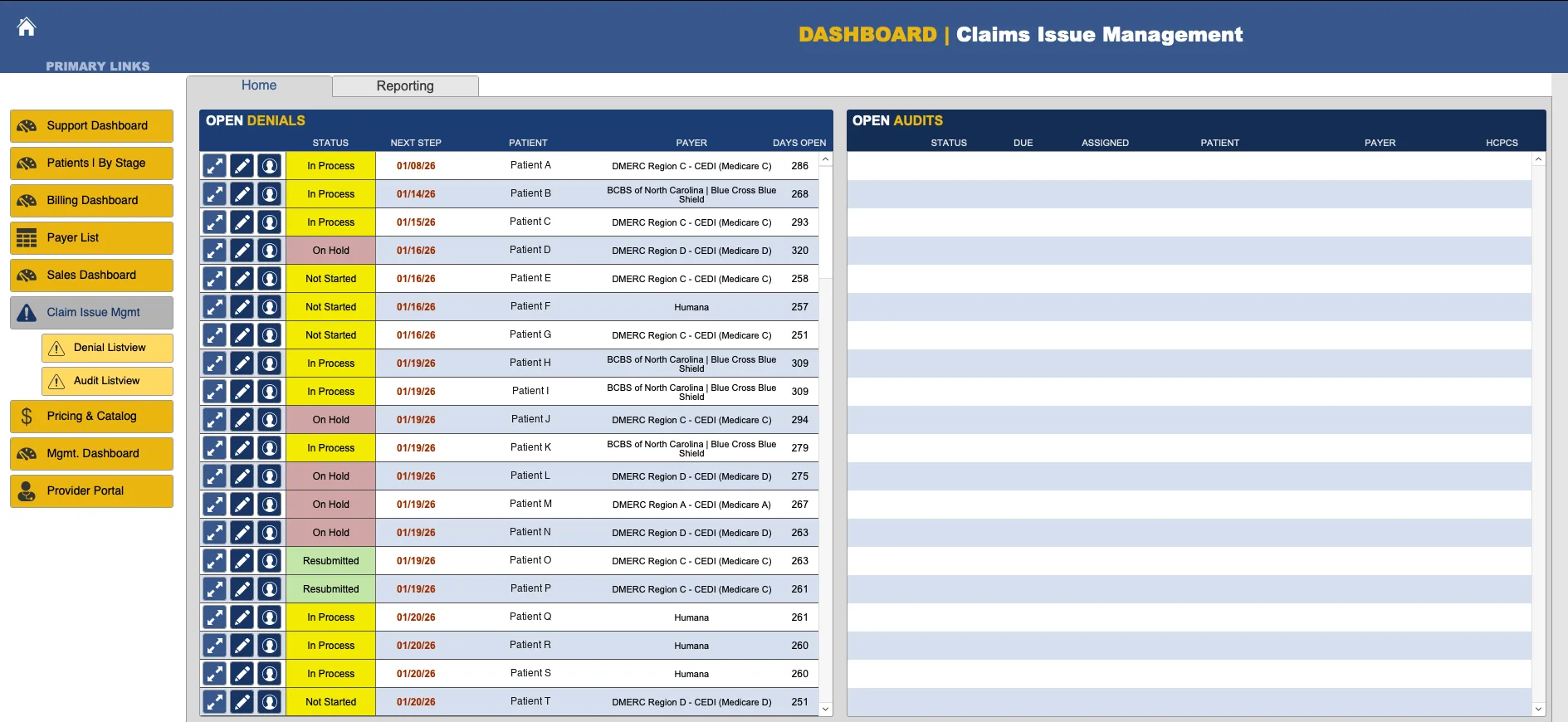
Patient issues are tracked from report to resolution, and audit management keeps the record of who did what, and when.
Two-way NikoHealth connection
The system uses NikoHealth’s API wherever it can. Where the API can’t do the job, an RPA service enters the data instead.
Provider and referral portal
Providers and referral sources see every order they’ve placed: whether the company can supply it under the patient’s insurance, and when it shipped. Adding a new patient takes a short form, and the patient lands in the process flow straight away. It was built for customers who’d asked to know where their patients stood.
Sales dashboard and iPhone app
Reps see the leads that came in this month, their commissions and the live status of every order, at a desk or on an iPhone in the field. Because they could look it up, they stopped calling operations and management for updates. Every sale is attributed to its rep as it comes in, so the monthly arguments over attribution all but went away. It shows what sales needs, not what operations needs, and it meant no extra NikoHealth seat licenses.
Management dashboard
Real-time numbers on the patients in the pipeline, the ones going stale, new patient growth and cancellations, and which channel each new patient came from, so management can see which marketing is working. It replaced the month-end reports. NikoHealth didn’t provide any of it.
Prescriptions from pharmacies
Through an API integration with ScriptCycle, a pharmacy that can’t fill a prescription because it’s a Medicare Part B item sends it to the company automatically.
All of it runs on Microsoft Azure, with Azure Event Grid and Azure Communication Services, AI from Anthropic, and patient data in Neon’s HIPAA-compliant Postgres, and a BAA in place for every platform that touches patient data. None of these tools replaced NikoHealth. Each one does something NikoHealth didn’t. Compliance also depends on how an organization uses the system.

What changed.
The management hours are a typical month; busier months took longer. Sales reps stopped calling operations and management for order updates, and the monthly disputes over attribution all but went away. There’s no before figure for the error rate, so the page doesn’t claim a size for the drop, only where it ended up. Offshore staffing before the system isn’t on record yet and is marked as pending above.

A patient moves forward when every step is done right, not when someone clicks next.
Controls an offshore team can work inside.
The ERPs could record what happened. This system decides what's allowed to happen next.
No step gets skipped
Each stage has its own controls. A patient moves forward only when the checklist is complete and every answer is the right one, or when a manager approves the exception on the record.
AI recommends, a person decides
GenHealth’s review and Dialpad’s summaries save the team reading time. The approval to serve a patient still comes from a person who has checked the recommendation.
API first, RPA only where it has to be
Everything that NikoHealth’s API could do went through the API. RPA covers only the gaps, which keeps the fragile part of the connection as small as possible.
Each person sees their own work
Operations, management, providers and sales each have a view built for what they need, on the same data. Reps don’t wade through an operations screen, and neither they nor providers have to call to ask where an order stands.
Phased, while the company kept shipping.
This was a core build, and the company couldn’t stop running while it happened. We worked with management, operations and the offshore BPO team together, moved the company off its existing system, and generated the training material each team used.
The rollout went one component at a time. Each part went live and settled in before the next one depended on it.
What is manual work costing your business?
Repetitive admin, missed follow-ups and disconnected systems take time away from running your business. Bring us one process that slows your team down. We'll help you understand what could improve, how much time you could recover, and what it might cost to implement.
Get My Free Workflow ReviewFree 30-minute conversation about how your business runs. Practical recommendations. No obligation.
Not sure where to start? That's what the free call is for. We'll walk through how your business runs and find the easiest wins, the places where automation and AI agents can take work off your team first.
Prefer to talk? Call (435) 243-5808 about your workflow, or .