
Real-time sales tracking beside Brightree, from the rep who brought in a referral to the order that shipped.
A medical supply company ran its orders through Brightree’s cloud-based system. Brightree could report on sales, but building those reports was onerous and slow, each one was a snapshot rather than real-time business intelligence, and none of them was made for a sales manager. Every month the sales VP spent 5 days pulling commission, channel and churn reports by hand, and management still ran about 45 days behind what the reps were doing. Which rep brought in which patient, through which channel, from which office? Which orders shipped, which couldn’t be serviced, and what was each rep owed? An established HME solutions platform that integrates with Brightree quoted more than $30,000 to implement and over $2,500 a month to run, and it wouldn’t have calculated commissions or tagged patients by intake channel. Loque Logic integrated with Brightree’s cloud system and built the answers in real time, with a dashboard for management and a phone app for reps in the field. Reps’ calls to the production team fell 70%, and the sales VP’s reporting went from more than 5 days a month to under 30 minutes.
Free 30-minute conversation about how your business runs. Practical recommendations. No obligation.
Prefer to talk? Call (435) 243-5808 about your workflow, or .
The case study, in five parts.
Every case study we publish reports the same five things, so you can judge the result for yourself.
- The workflow
- Sales attribution, channel tracking, order outcomes and commissions for a medical supply company whose orders run through Brightree’s cloud-based system. Connect and build: every lead is captured as it comes in and stored in our Neon database, where Brightree’s data and order statuses are matched to the marketing and sales data from the channels, the reps and intake. Only a limited set of data is kept in Neon, and it’s encrypted. Brightree updates come in through RPA whenever they’re needed, and in scheduled pulls every night.
- The baseline
- Brightree could report on sales, but producing those reports was onerous and time-consuming, and each one showed the moment it was run rather than a live view. They weren’t set up for a sales manager. Every month the sales VP spent 2 days pulling commission reports, then another 3 days, all told, pulling and matching channel data, churn reports, channel sales and updates for management: 5 days a month on reporting. Even then, management ran about 45 days behind the reps’ activity, which left blind spots where a rep was struggling. Channel marketing ran without data anyone could act on. And reps called the operations team all the time to ask where an order stood.
- The volume
- Every lead from every channel, every rep in the field and every referring office, tracked from intake to shipment and on through churn, returns and time on therapy, plus the monthly commission run.
- The result, and its kind
- Capacity recovered. Sales reporting that took the sales VP more than 5 days a month now takes under 30 minutes, because the reports generate on their own or in one click. Reps’ calls to the production team fell 70%, and the calls that still come in are usually urgent. In a doctor’s office, a rep can now answer the office’s questions in real time, on the spot. Alongside that, management sees churn rates, marketing attribution, sales order counts and office order rates in near real time, so an office whose referrals are falling off, or a rep whose pace is slipping, shows up almost as it happens instead of about 45 days later.
- What it costs to run
- $655 a month: $370 for Vercel, $200 for the Anthropic API, $50 for the AWS server that runs the RPA, and $35 for Neon. There are no seat licenses. The established HME platform the company was quoted would have run more than $2,500 a month. It doesn’t cover the build, or our $1,500 a month maintenance, which is listed separately.
- Client
- A medical supply company that runs on Brightree’s cloud-based system
- The gap
- Brightree’s reports could answer the sales questions, but slowly, with real effort, and never in real time. They weren’t built for a sales manager, and the established HME platform the company was quoted cost more than $30,000 to implement and $2,500 a month to run
- Who used it
- Sales managers at a desk, and field reps on a phone app
- What it worked beside
- Brightree’s cloud-based system, kept for orders
- Stack
- Vercel, Neon’s HIPAA-compliant Postgres, AI from Anthropic, and RPA on an AWS server working Brightree’s cloud system, with scheduled nightly pulls and the Brightree API where it held up. Every platform that touches patient data is covered by a BAA
- Ongoing from us
- $1,500 a month covers fixing RPA and system issues, troubleshooting anything that comes up, managing staff changes, and a monthly HIPAA monitoring log. The system checks for unusual activity at a short, set interval; when it finds some, it shuts off that user’s access and alerts management and Loque Logic on screen
Brightree ran the orders. Its sales reports couldn’t keep up.
The company’s orders lived in Brightree’s cloud-based system, and it did that job. Getting sales answers out of it was the problem. Brightree could produce the reports, but each one was onerous and slow to pull together, and a report is a snapshot, not the real-time view a sales manager works from.
The company was quoted for an established HME solutions platform that integrates with Brightree: more than $30,000 to implement and over $2,500 a month to run, and it still wouldn’t have calculated commissions or tagged each patient with the channel they came in through. So Brightree stayed as the order system, and we integrated with its cloud system and built the real-time sales layer beside it.
- 01
Management ran 45 days behind
Every sales question meant building and running a report in Brightree. Pulling and matching channel data, churn reports, channel sales and updates for management took the sales VP 3 days a month. Even so, management was seeing the reps’ activity about 45 days after it happened, so a rep who was struggling could go unnoticed for weeks.
- 02
Not built for a sales manager
Brightree’s reporting is built around orders and billing, not around a sales team. Channel, rep and office performance, and how it changed from month to month, took real work to piece together, so channel marketing ran without data anyone could act on.
- 03
The orders that didn’t close took digging
Seeing which orders closed and which couldn’t be serviced, usually because of the patient’s insurance, meant working through the records. So did referring the unserviceable ones out when there was a referral path.
- 04
Commissions took 2 days a month
The sales VP spent 2 days every month pulling the commission reports and working out what each rep was owed.
- 05
Reps called in all the time
Reps had no simple way into order status, notes or insurance verification. So they called the operations team for updates, all the time, including when they were sitting with a doctor’s MA.
A sales layer beside Brightree, on a desk and in a pocket.
Managers get the whole team and every channel on one dashboard. Reps get their own orders on a phone.
Channel attribution
Every patient is tagged in our system with the channel they came in through, and the tag stays with them. Management can see which channels bring in patients and which of those patients ship, then compare churn, returns and how long patients stay on therapy, channel by channel.
Rep and office attribution
Each order is tied to the rep who brought it in and the office that referred it, as it arrives. Who brought in what is on record all month, not worked out at the end of it.
Order outcomes
Every referral is tracked to where it ended up: shipped, still in progress, failed, canceled or returned. The orders that couldn’t be serviced stay visible instead of dropping out of the count.
Commission calculation
Commissions are calculated from each rep’s shipped orders, with returns taken back off in the month they come back. Managers approve them and export the list for payroll.
Performance over time
Rep and office results line up month against month. A manager can see who’s ahead of pace, who’s slipping, and which offices are sending fewer referrals.
Management dashboard
The sales team and the marketing channels on one live screen, with no report to run: orders shipped, each rep’s pace against goal, leads and ship rate by channel, returns and commissions due.
A phone app for field reps
Reps see their pipeline, each patient’s status, the notes on the account and the insurance verification, live. In the office with the MA, a rep can say exactly where each patient stands.
Intrusion detection
At a short, set interval, the system checks for unusual activity. When it finds some, it shuts off that user’s access straight away and puts an alert on screen for management and for Loque Logic. Each month’s activity goes into a HIPAA monitoring log.
Reading from Brightree
Brightree’s data and order statuses come in through RPA whenever they’re needed, and in a scheduled pull every night. Only a limited set is kept in Neon, encrypted, beside the sales and marketing data it’s matched to.
It runs on Vercel, with patient data in Neon’s HIPAA-compliant Postgres, AI from Anthropic, and the RPA on a server at AWS, and a BAA in place for every platform that touches patient data. None of it replaced Brightree. It reads what Brightree already holds and shows it to the people who need it, in the form they need it. Compliance also depends on how an organization uses the system.
What reps and managers see.
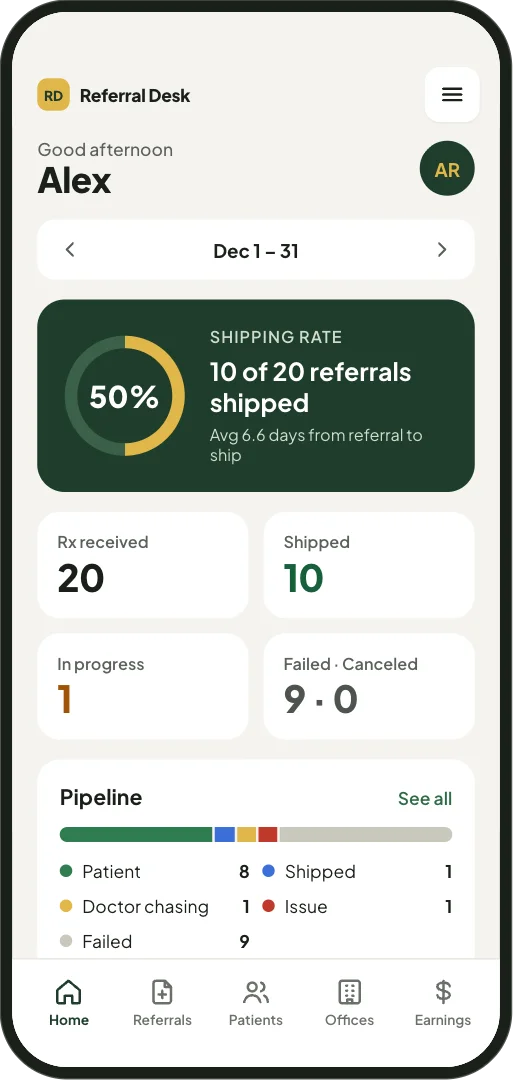
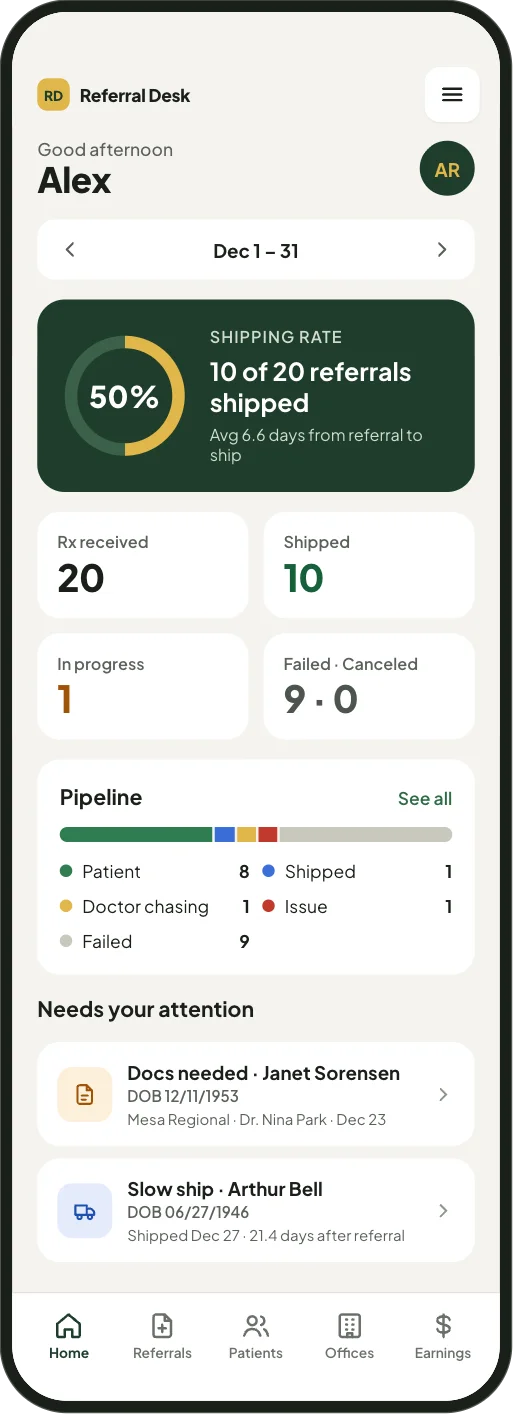
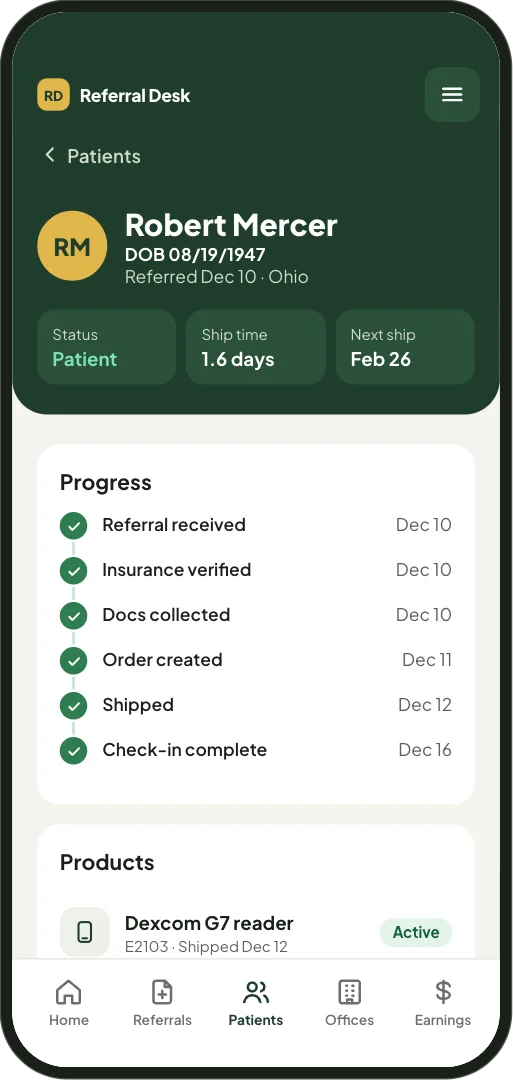
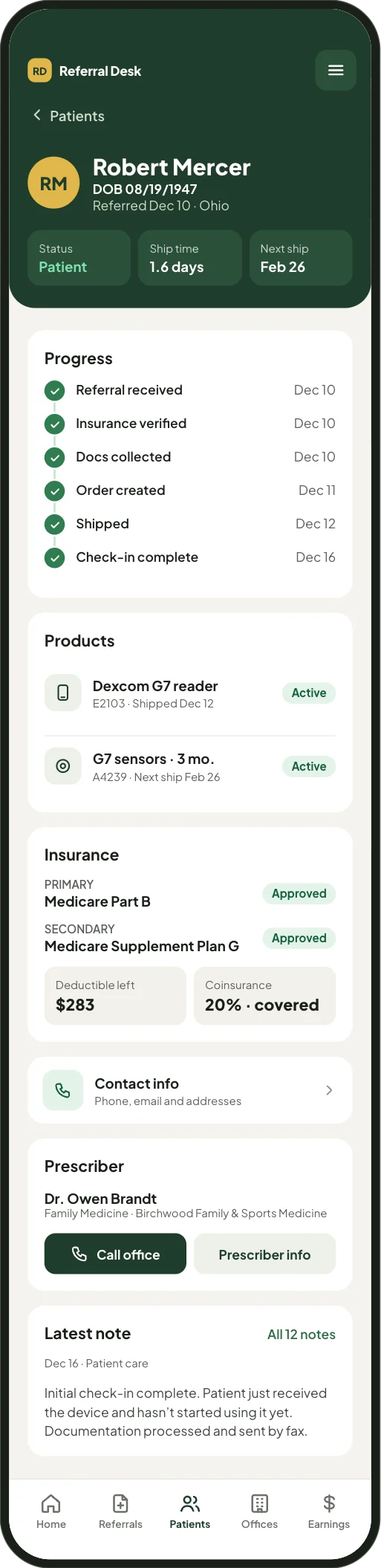
The rep’s phone app first, then the manager’s desktop. All of the data on these screens is test data, not the client’s, and no figure on them is a result.
The month at a glance
A rep opens the app to their own month: referrals received, how many have shipped, what’s still in progress and what failed. The pipeline shows every patient by stage. A short list flags what needs the rep, like documents a doctor’s office still owes or a shipment running slow.
Every name and figure on this screen is test data.
Every patient, step by step
Each patient’s progress runs from referral through insurance verification, documents, the order, shipping and check-in, with the date of every step. Products, insurance and the latest note sit underneath. It’s what a doctor’s MA tends to ask about, so the rep can answer on the spot.
Every name and figure on this screen is test data.
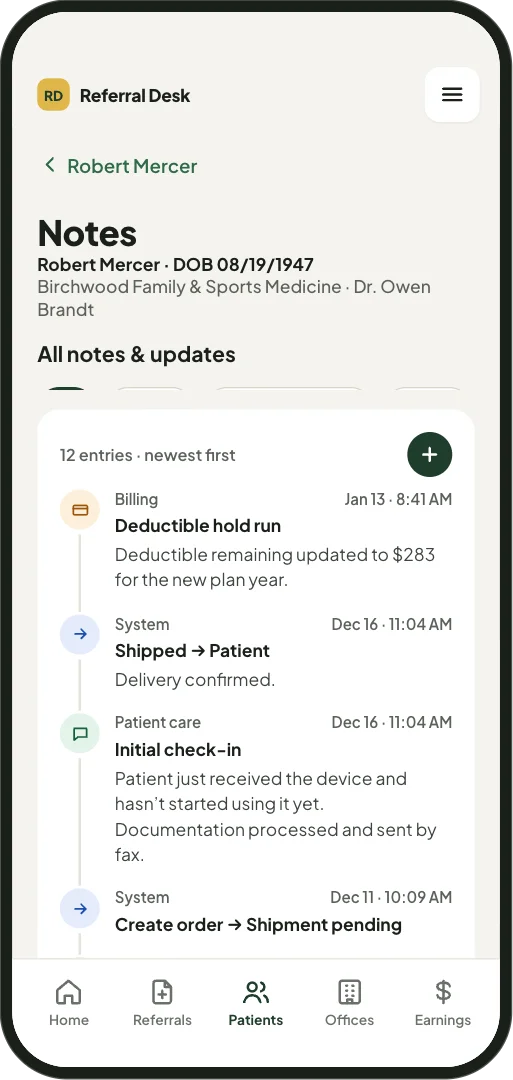
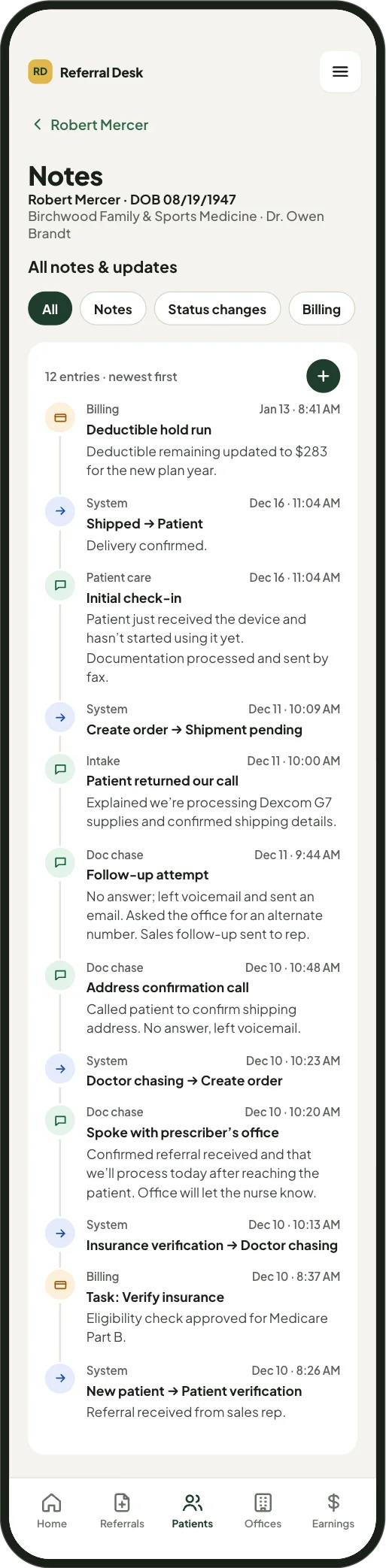
Every note and update, in one place
The whole history on a patient, newest first: notes from intake, doc chase and patient care, every change of status, and billing updates such as insurance checks. Filters narrow it to one kind of entry, and a rep can add a note from the field. When an office asks what happened last, the answer is here.
Every name and figure on this screen is test data.
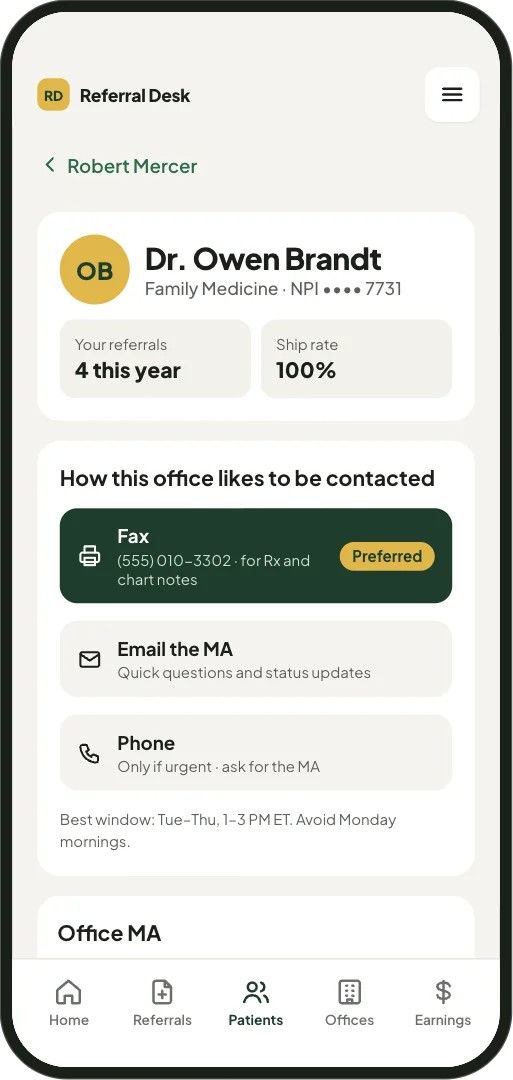
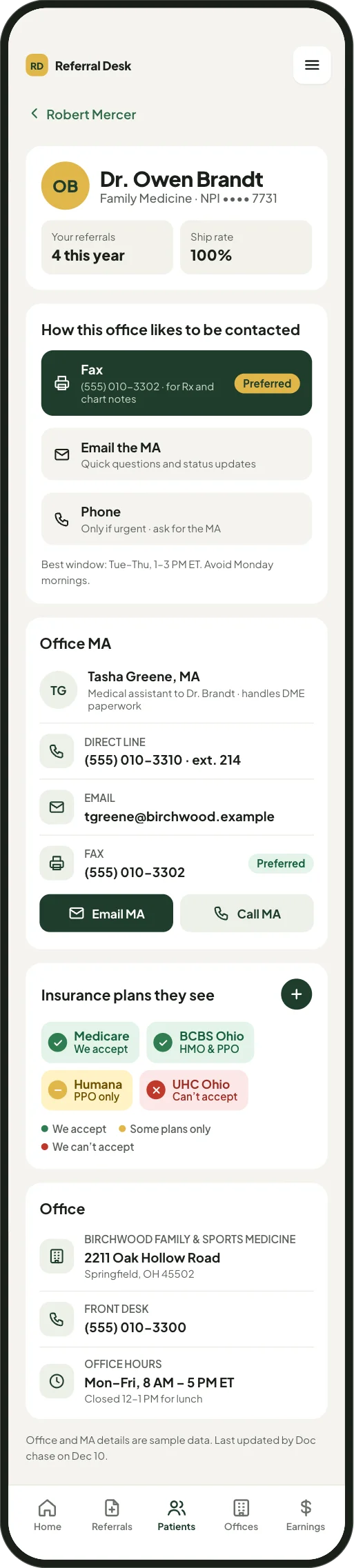
How each office likes to be contacted
For every prescriber there’s the office’s preferred channel (fax, an email to the MA, or a call only when it’s urgent), the best time to reach them and the MA’s direct details. It also shows which insurance plans the company can accept for that office’s patients, kept current by the managers.
Every name and figure on this screen is test data.
What they’ve earned, as it happens
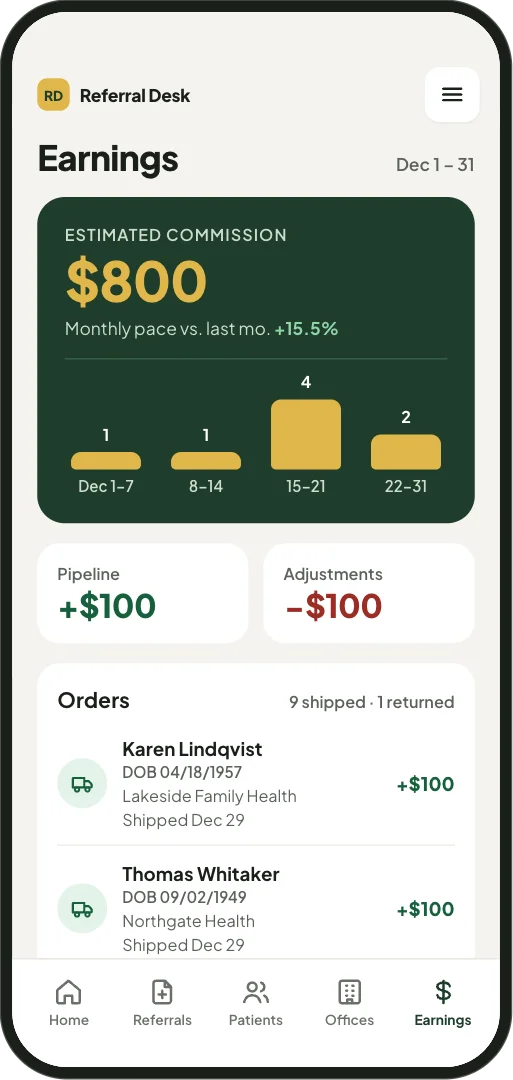
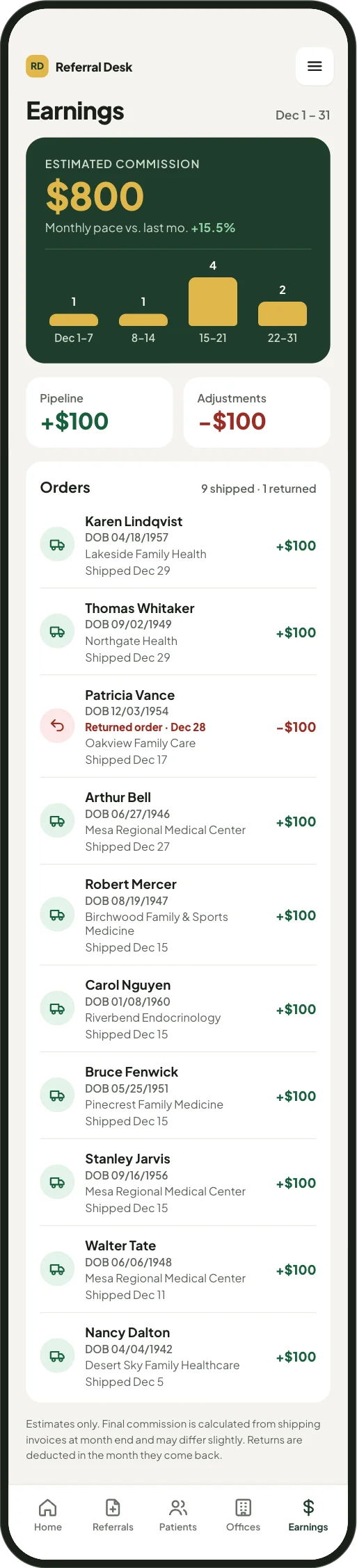
Reps see their estimated commission for the month, their orders by week and every order behind the total. A returned order comes off in the month it comes back, listed beside the order it came from, so every deduction is easy to trace.
Every name and figure on this screen is test data.
The month so far, on one screen
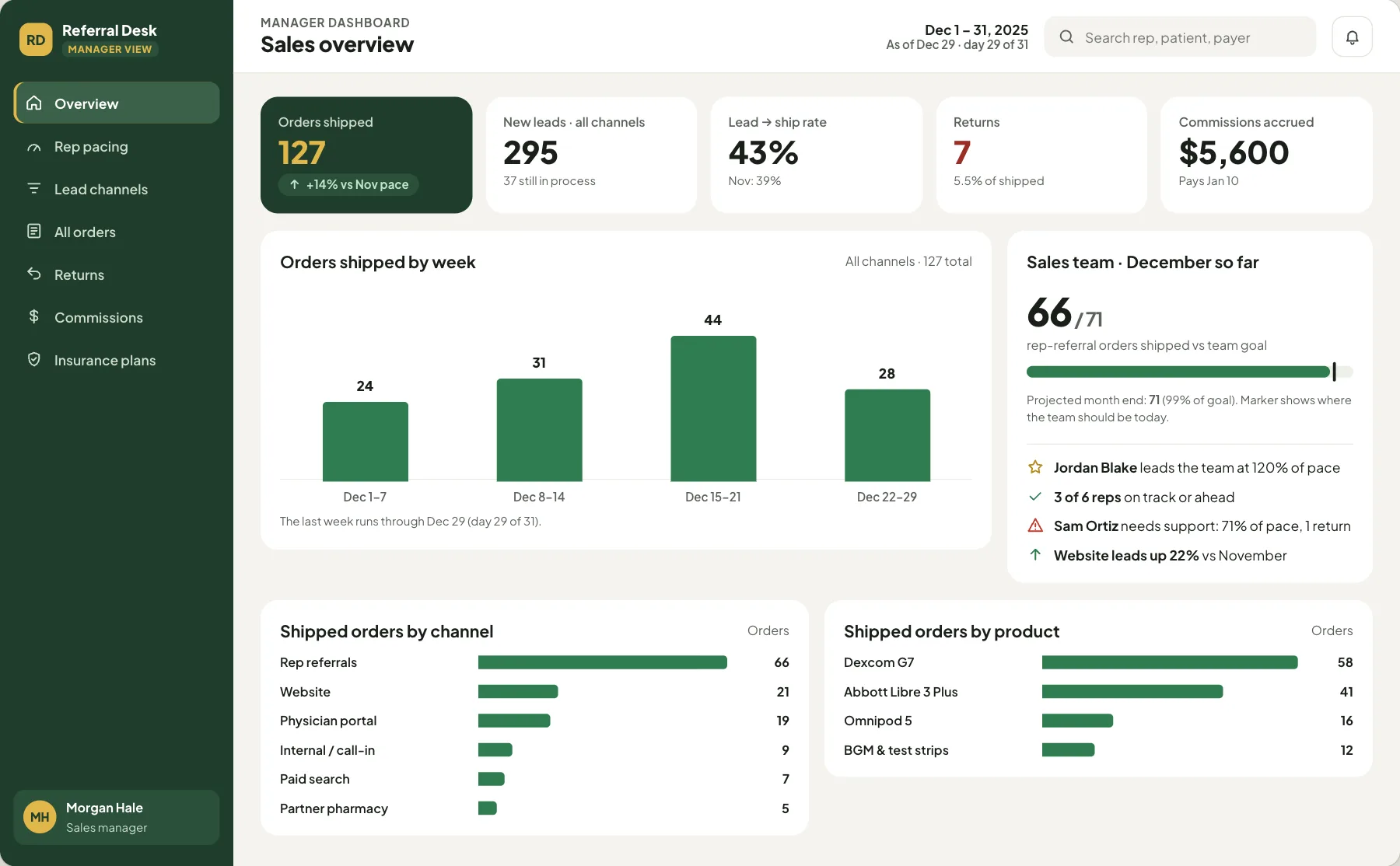
Managers open to orders shipped, new leads across every channel, the lead-to-ship rate, returns and commissions accrued, each against the month before. Underneath are orders by week, the sales team against its goal, and shipped orders by channel and by product. The reps who are ahead, and the ones who need support, are called out by name.
Who’s on pace, and who needs help
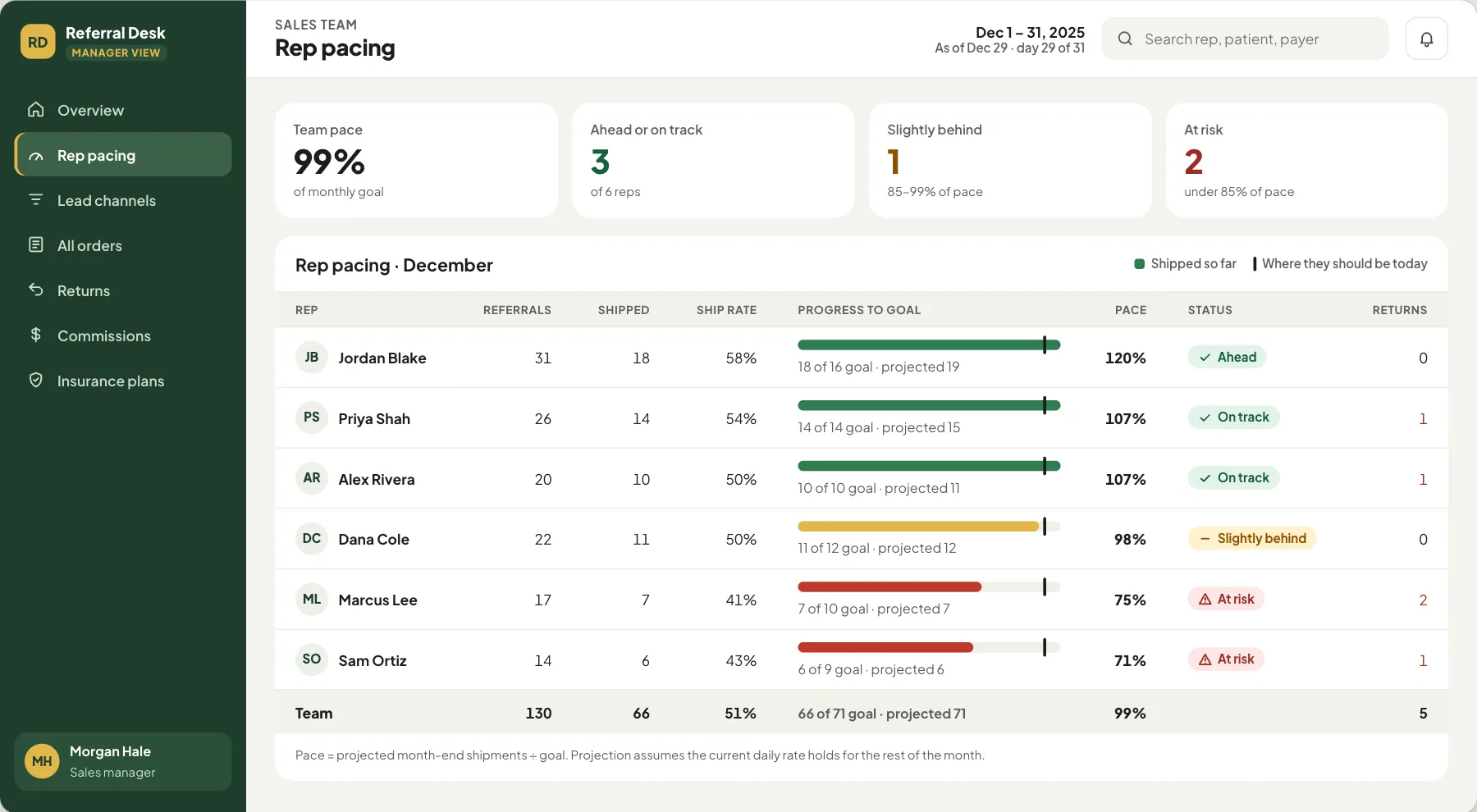
Every rep’s referrals, shipped orders and ship rate, with a bar for progress to their monthly goal and a marker for where they should be by today. Pace projects the month’s end from the current rate, so a manager can step in while there’s still time to make a difference. Returns sit in the same row.
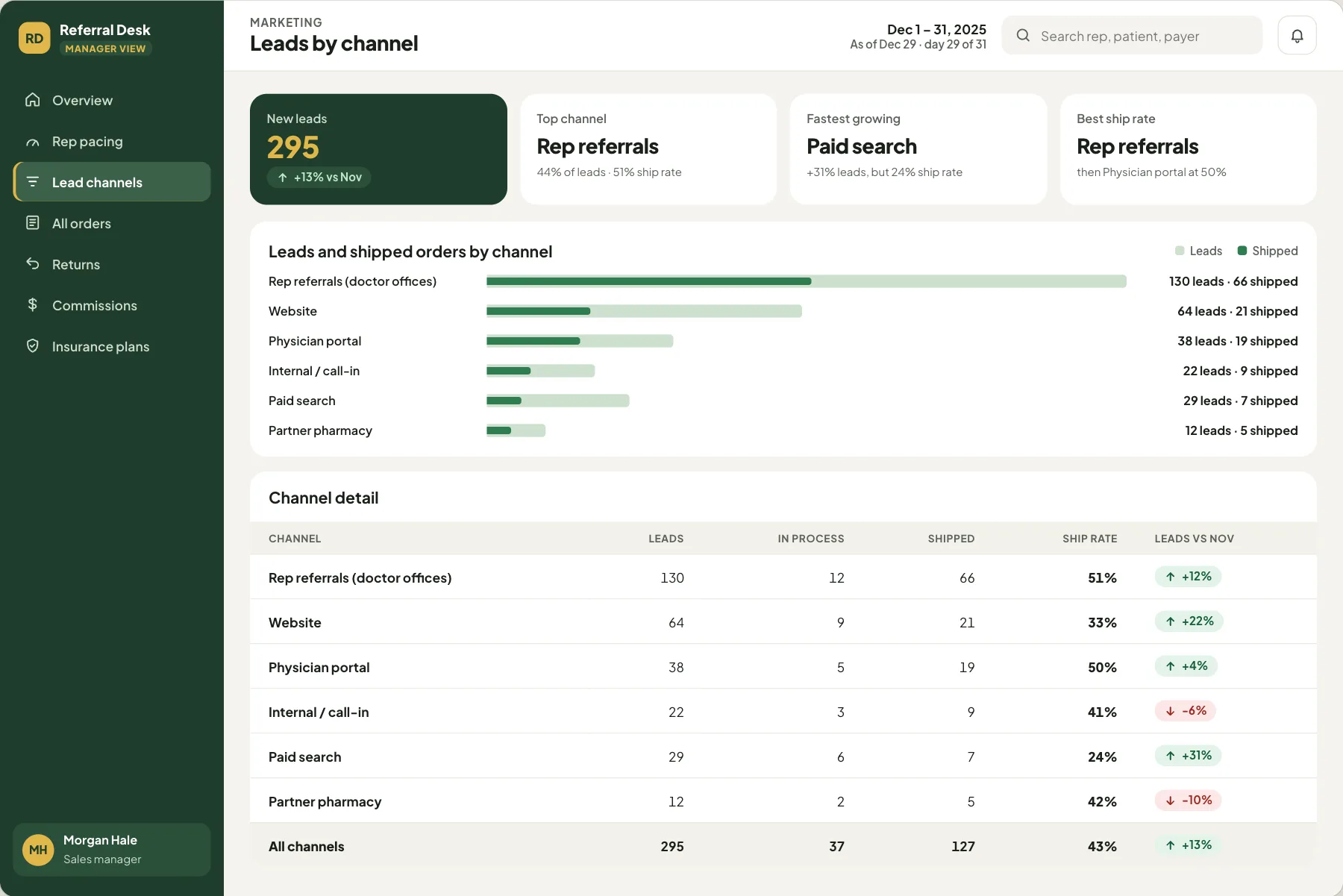
Which marketing brings in patients who ship
Leads and shipped orders side by side for every channel, then a table with the orders still in process, the ship rate and the change on last month. A channel that brings in plenty of leads and few shipments stands out at a glance. Because every patient keeps their intake channel, a channel’s patients can be followed long after the first order.
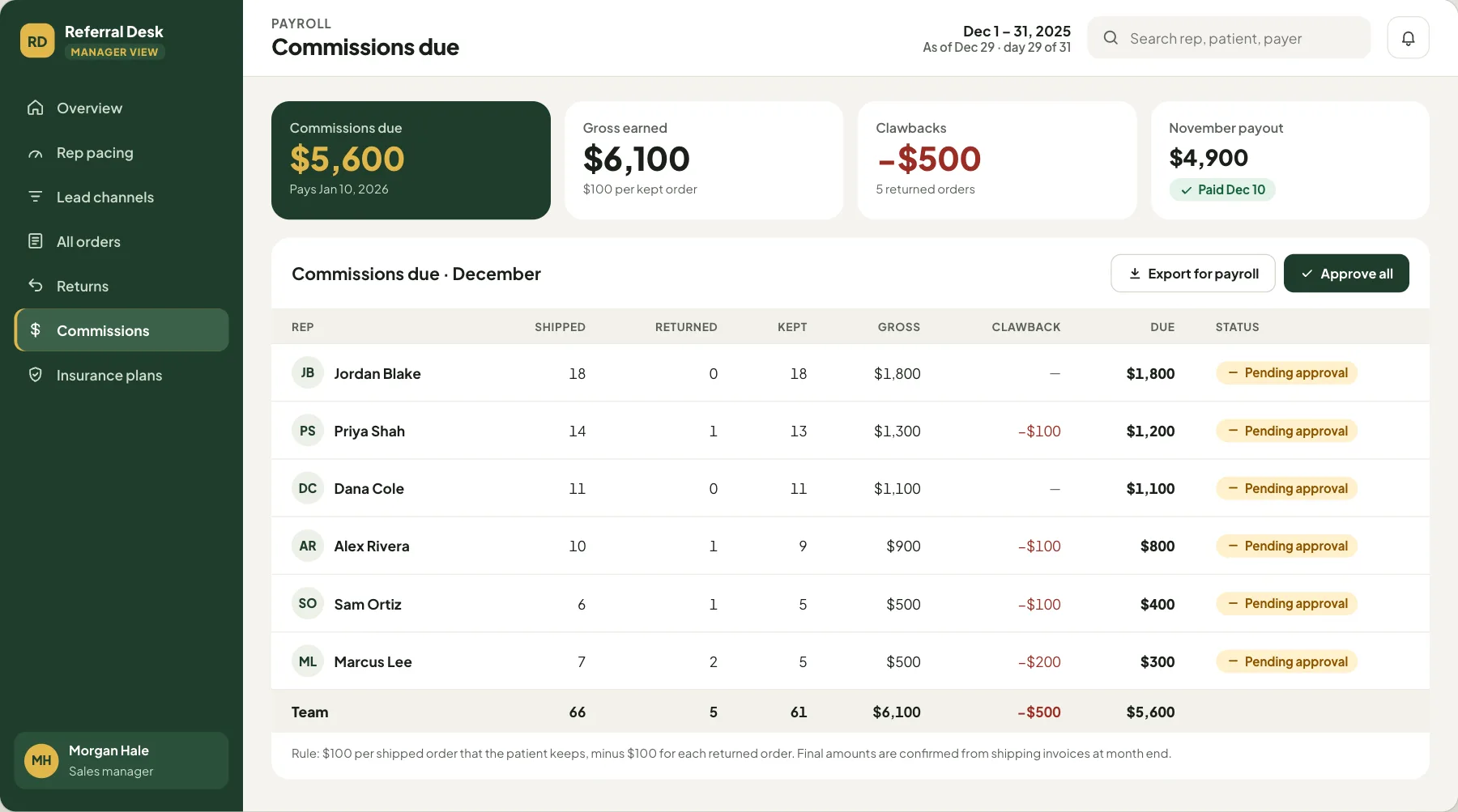
Commissions, ready for payroll
Each rep’s shipped, returned and kept orders, their gross commission, any clawback for returns, and the amount due, with the team total underneath. Managers approve the month and export it for payroll. The rule behind the numbers is printed on the page, so nobody has to ask how a figure was reached.
What changed.
The reports that took more than 5 days now generate on their own or in one click. Reps don’t have to call anyone to answer an office: what the MA asks about is already on their phone. Management also has actionable numbers it didn’t have before: churn rates and marketing attribution by channel, and each office’s order rate as it changes, so an office sending fewer referrals or a rep falling off pace can be picked up straight away. It all runs for $655 a month, with no seat licenses, where the established HME platform the company was quoted would have cost more than $30,000 to implement and over $2,500 a month.

Every order knows who brought it in, from the moment it arrives.
Attribution that happens once, at the start.
Most sales tracking is reconstructed after the fact. This system records it when the order comes in, and everything else reads from that.
Attribute it when it arrives
An order is tied to its rep, office and channel the moment it comes in. There’s nothing to reconstruct at month end.
Give reps what the office asks
Status, notes and insurance verification are on the phone, because that’s what an MA wants to know.
Go with what holds up
The build started out leaning on Brightree’s API. Getting the API to work reliably for this job was a hard slog, so the connection moved mostly to RPA and scheduled nightly pulls, which did hold up.
What is manual work costing your business?
Repetitive admin, missed follow-ups and disconnected systems take time away from running your business. Bring us one process that slows your team down. We'll help you understand what could improve, how much time you could recover, and what it might cost to implement.
Get My Free Workflow ReviewFree 30-minute conversation about how your business runs. Practical recommendations. No obligation.
Not sure where to start? That's what the free call is for. We'll walk through how your business runs and find the easiest wins, the places where automation and AI agents can take work off your team first.
Prefer to talk? Call (435) 243-5808 about your workflow, or .